



Dedicated Software Development Team: When It Works, What It Costs, and How to Manage It

- What Is a Dedicated Software Development Team?
- When a Dedicated Team Makes Sense
- When It Is the Wrong Model
- Dedicated Team vs Staff Augmentation vs Fixed-Price Outsourcing
- What Roles Should a Dedicated Software Team Include?
- Why Front-End Skills Matter More Than Many Teams Expect
- Choosing the Right Technology Stack
- Look for Product Experience, Not Just Resumes
- Review the Vendor’s Broader Work
- How Dedicated Team Pricing Usually Works
- How to Keep Control Without Micromanaging
- Legal, IP, and Access Questions to Clarify Early
- Red Flags When Choosing a Dedicated Software Team
- Checklist Before You Hire a Dedicated Team
- The Best Dedicated Teams Feel Like Product Partners
A company usually starts looking for a dedicated software development team when the roadmap has outgrown the team behind it.
The product needs new features. Customers are asking for improvements. The internal developers are busy with maintenance, bugs, and urgent requests. Hiring takes too long. Freelancers feel too fragmented. A fixed-price agency project feels too rigid because the product is still changing.
This is where the dedicated team model becomes attractive.
It gives a company steady engineering capacity without forcing it to hire every role internally from day one. For companies that prefer a smaller, product-minded partner, the Hutko team is one example of a software group that works across design, engineering, and product delivery.
Still, a dedicated software team is not a shortcut. It only works when the company has clear product ownership, fast feedback, realistic priorities, and a vendor that can manage delivery without hiding risks.
What Is a Dedicated Software Development Team?
A dedicated software development team is a long-term external team that works mainly or exclusively on one client’s product.
Unlike a freelancer, it usually includes more than one role. Unlike a fixed-price project, it is built around ongoing roadmap delivery rather than one locked scope. Unlike staff augmentation, the vendor often helps manage team structure, continuity, process, and technical quality.
The client owns product direction. The external team helps turn that direction into working software.
This model is common for SaaS platforms, internal business tools, marketplaces, mobile apps, customer portals, admin dashboards, healthcare systems, logistics tools, and long-term product development.
The value is not just extra developers. The value is product knowledge that grows over time.
When a Dedicated Team Makes Sense
A dedicated development team works best when the product will keep evolving.
It may be useful after an MVP has been validated and the company needs to improve the product, add integrations, reduce technical debt, and prepare for more users. It also works well when an internal team lacks specific skills in frontend, backend, QA, DevOps, or UX design.
Digital agencies also use this model when client demand becomes too unpredictable for an internal team alone. One month may require a full product build. Another may require maintenance, QA, or support. A dedicated external team gives them capacity without hiring for every possible peak.
The model makes the most sense when the roadmap is longer than a few months and the company wants continuity, not one-off delivery.
When It Is the Wrong Model
A dedicated team is not the right answer for every project.
If the task is small, one freelancer may be enough. If the scope is fixed and unlikely to change, a fixed-price project may be simpler. If the company wants to manage every developer directly, staff augmentation may be a better fit.
The model also fails when nobody on the client side can make product decisions.
An external team can advise, build, test, and manage delivery. It cannot decide the business strategy alone. Someone still needs to approve priorities, clarify scope, review work, and answer product questions quickly.
Without that ownership, even a strong team slows down.
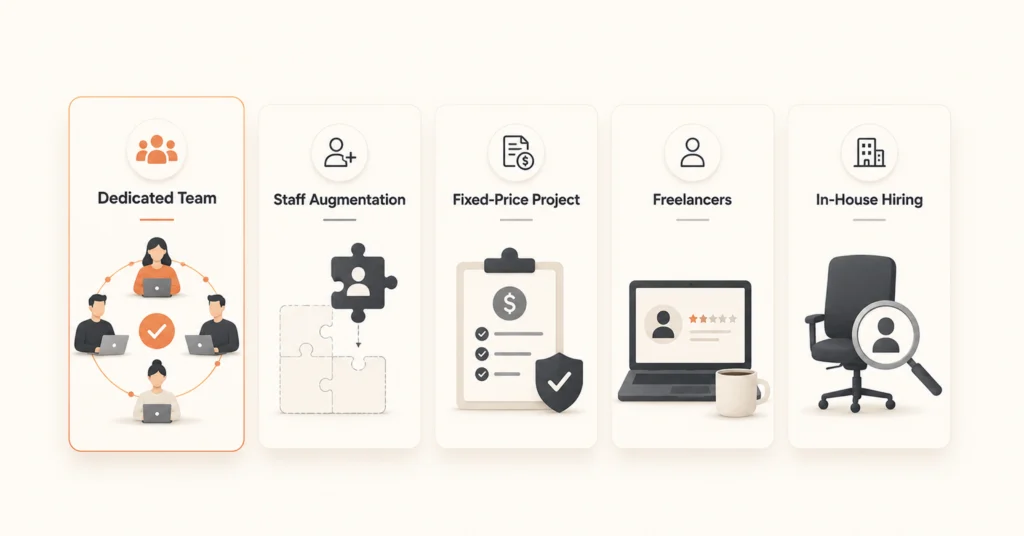
Dedicated Team vs Staff Augmentation vs Fixed-Price Outsourcing
These models are often grouped together, but they solve different problems.
| Model | Best for | Main advantage | Main risk |
| Dedicated team | Long-term product roadmap | Continuity and product knowledge | Needs strong governance |
| Staff augmentation | Filling skill gaps inside an existing team | Fast access to talent | Client manages delivery |
| Fixed-price project | Clear and stable scope | Budget predictability | Low flexibility when requirements change |
| Freelancers | Small tasks or short-term support | Low commitment | Limited availability and coverage |
| In-house hiring | Core strategic product ownership | Full control | Slow and expensive hiring |
The dedicated team model sits between outsourcing and internal hiring. It gives the client more continuity than a project-based vendor, but less hiring burden than building the full department internally.
What Roles Should a Dedicated Software Team Include?
The team structure depends on the product.
A small MVP may need one full-stack developer, a UX/UI designer, QA support, and part-time technical leadership. A larger platform may need frontend and backend developers, a tech lead, QA engineer, project manager, DevOps support, and sometimes a business analyst.
Two roles are often underestimated: tech lead and QA.
A tech lead protects architecture, reviews technical decisions, and keeps the codebase maintainable. QA protects releases, tests edge cases, and helps prevent small bugs from becoming customer-facing problems.
Cutting these roles may reduce the monthly invoice, but it can create more rework later.
Why Front-End Skills Matter More Than Many Teams Expect
Many modern software products are judged through the frontend first.
A dashboard can have strong backend logic and still feel weak if the interface is slow, confusing, or difficult to use. A customer portal can lose trust if forms behave poorly on mobile. A SaaS product can struggle with adoption if onboarding feels messy.
Frontend work now includes design systems, accessibility, performance, component architecture, state management, API integration, and responsive behavior. Before choosing a dedicated team, it is worth understanding how modern front-end work is evolving, especially if the product depends on complex dashboards, portals, or interactive user flows.
Good frontend engineering is not just about making screens look finished. It affects maintainability, user confidence, and how quickly the product can change later.
Choosing the Right Technology Stack
The technology stack should follow the product, not the vendor’s favorite tools.
A SaaS dashboard, internal portal, ecommerce platform, and mobile backend may all need different decisions. The team should consider the existing codebase, future roadmap, available developers, integration needs, performance, security, and long-term maintenance.
React is often a strong option for SaaS products, marketplaces, admin panels, and interactive web applications because it supports reusable components and flexible frontend architecture. If the product already depends on a React-based interface, working with a team that can provide React engineering support may reduce onboarding time and make future UI work easier to maintain.
The same principle applies to backend, cloud infrastructure, databases, and APIs. The best stack is not the trendiest one. It is the one the team can build, test, support, and scale responsibly.
Look for Product Experience, Not Just Resumes
A vendor can show impressive resumes and still be the wrong fit.
Dedicated teams need product experience, not only technical skills. The team should understand workflows, user roles, dashboards, integrations, reporting, admin tools, and release pressure.
For example, a healthcare workflow platform build can show how a team handles scheduling, field staff coordination, admin visibility, operational workflows, and sensitive user scenarios.
One case study will not tell the whole story, but it helps reveal whether the team has worked with real product complexity.
Review the Vendor’s Broader Work
One strong example is useful. A broader body of work is better.
Before signing a long-term engagement, it helps to review selected product work and see whether the team has delivered more than one type of digital product.
Look for range. Has the team worked on web platforms, mobile interfaces, admin dashboards, customer-facing products, internal tools, and integrations? Does the work look custom, or does every project feel like the same template?
A good portfolio should show how the team thinks, not only how the screens look.
How Dedicated Team Pricing Usually Works
Dedicated software development teams are usually billed monthly.
The price depends on team size, seniority, location, project complexity, and which roles are included. A small team may include one or two developers with part-time QA and project management. A larger team may include frontend, backend, QA, DevOps, design, and technical leadership.
Pricing may be based on a monthly retainer, time and materials, or dedicated capacity. Some specialists may be part-time if the project does not need them every day.
A low monthly rate can look attractive, but it may exclude the roles that protect delivery: QA, tech leadership, project management, documentation, or DevOps support. If those gaps are ignored, the client often pays later through delays, bugs, rework, and unclear ownership.
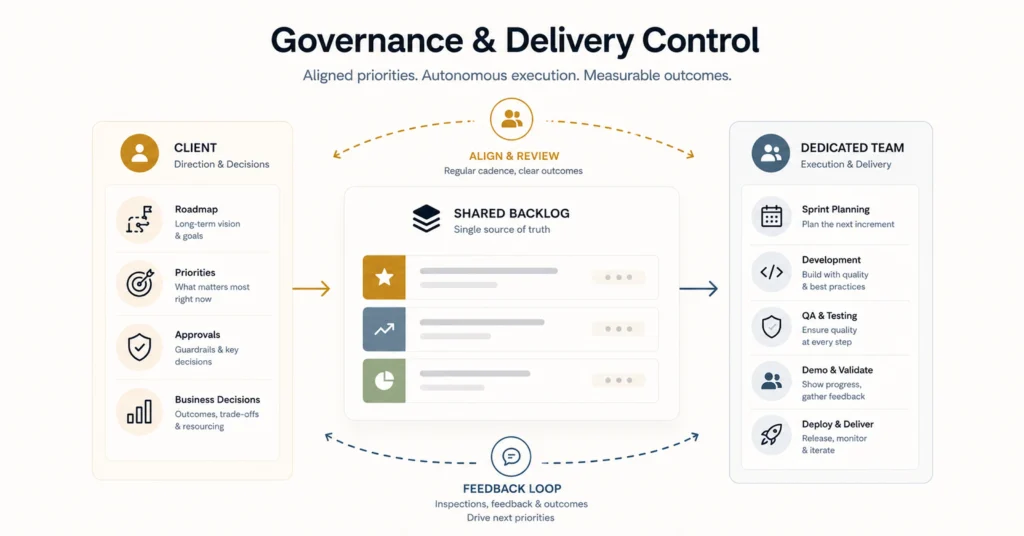
How to Keep Control Without Micromanaging
A dedicated team works best when responsibilities are clear.
The client should control product direction. The vendor should manage delivery execution. That means the client owns the roadmap, priorities, approvals, and business decisions, while the team owns technical implementation, sprint delivery, quality control, and communication.
Weekly demos are more useful than long status reports. A shared backlog keeps priorities visible. Written acceptance criteria reduce misunderstandings. Technical decision records help explain why certain choices were made.
The client should not disappear after signing the contract.
Dedicated teams need fast feedback, clear priorities, and someone who can make decisions when trade-offs appear.
Legal, IP, and Access Questions to Clarify Early
Legal and ownership questions should be settled before development starts.
The contract should cover NDA terms, IP ownership, source code ownership, design file ownership, repository access, cloud accounts, third-party service accounts, data security, compliance needs, documentation, and handover rules.
Whenever possible, the client should control key accounts. The vendor can help manage repositories, infrastructure, analytics, deployments, and app accounts, but the business should not lose access to its own product assets.
This is not only a legal issue. It affects continuity if the team changes later.
Red Flags When Choosing a Dedicated Software Team
Some warning signs appear before the contract is even signed.
- No clear team structure.
- No tech lead.
- No QA process.
- No delivery manager or project manager.
- No explanation of what happens if a developer leaves.
- No repository access for the client.
- No written handover process.
- Weak case studies or vague portfolio examples.
- Estimates that avoid assumptions.
- Unrealistic timelines.
- Unclear IP ownership.
- Poor communication during sales calls.
A serious partner will not say yes to everything. They will challenge weak assumptions, flag risks, and explain when a simpler approach is better.
Checklist Before You Hire a Dedicated Team
- Do we have a product owner?
- Is the roadmap at least partly defined?
- Do we know which roles we need?
- Do we understand the difference between a dedicated team and staff augmentation?
- Is QA included?
- Is a tech lead included?
- Are communication rules clear?
- Who owns the source code?
- Who controls infrastructure and app accounts?
- How often will demos happen?
- What happens if a team member leaves?
- Can the team scale up or down?
- What documentation will be delivered?
- Is post-launch support included?
The Best Dedicated Teams Feel Like Product Partners
A dedicated software development team can be a strong option when a company needs long-term delivery capacity, product knowledge, and flexible execution.
It is not the right model for every project. Small tasks may be better handled by freelancers. Fixed scopes may fit fixed-price work. Companies with strong internal leadership may prefer staff augmentation.
But when the roadmap keeps changing and the product needs steady engineering attention, the dedicated team model can give a business the continuity it needs without the delay of building every role internally.
The best relationships are built on clear ownership, frequent communication, measurable progress, and realistic expectations.
The client owns the product direction. The external team owns disciplined execution.
That balance is what makes the model work.

Free website strategy session with a senior web expert
For over a decade, we’ve helped startups, SaaS companies, and service brands build high-performing websites that drive real results. Whether you’re planning a redesign, launching a new product, or need to scale your platform—our technical and UX expertise can help you move faster and smarter.
Ready to talk? Connect with a lead developer at Hutko.dev for a FREE 30-minute strategy call. Let’s map out your next step, together.
Book a Free Call
