



Custom Software Solutions in 2026: Why Growing Companies Are Building Their Own Tools

- What Custom Software Really Means
- Custom Software vs Off-the-Shelf: The Practical Trade-Off
- What Companies Build With Custom Software
- Industries Where Custom Software Pays Off
- IoT and Cloud Are Making Custom Software More Important
- How Custom Software Gets Built
- Technologies Behind Custom Software in 2026
- What Custom Software Costs
- Measuring ROI Without Guesswork
- How to Choose a Software Partner Without Regretting It Later
- The Custom Software Trends Worth Watching in 2026
- Mistakes That Make Custom Software More Expensive Than Planned
- Is Custom Software Worth It?
-
Questions Business Owners Usually Ask
- What is a custom software solution?
- When is custom software better than buying a ready-made tool?
- What are examples of custom software for IoT?
- Where can a company find custom cloud software solutions?
- How do you measure ROI from custom software?
- How much does custom software development cost?
- How long does it take to build?
- Who offers the best custom software solutions?
Walk into almost any growing company, and the software story sounds familiar.
The problem is not that the business has no tools. Usually, it has too many. Sales works in a CRM. Finance closes the month in accounting software. Operations tracks tasks somewhere else. Marketing watches its own dashboards. Then, quietly, spreadsheets appear in the gaps because none of these systems fully matches the way the company actually runs.
At the beginning, nobody worries about it. Buying software is faster than building anything. A team needs to solve a problem today, so it signs up for a platform, connects a few integrations, and moves on. For a while, that is the right decision.
The trouble starts when the business grows past the shape of those tools.
The sales process becomes more specific than the CRM allows. The ecommerce team needs rules the platform was not built for. Reports take too long because the numbers live in different systems. Employees copy the same data twice because the integration only works halfway. Managers stop trusting dashboards and go back to asking one person who “knows the spreadsheet.” Customers wait because someone inside the company has to check three places before giving them an answer.
That is usually when the conversation changes.
The question is no longer, “Which tool should we buy?”
It becomes, “Why are we building our business around software that does not fit us anymore?”
What Custom Software Really Means
Custom software is software built for a specific business, workflow, or product model. It may be a web platform, mobile app, internal dashboard, customer portal, CRM, ERP, automation tool, ecommerce system, IoT dashboard, or cloud-based application.
The important word is not “software.” It is “custom.”
Off-the-shelf software is built for a broad market. Custom software is built around one company’s users, data, rules, approvals, integrations, reporting needs, and growth plans.
A public project management tool is a software product. A private operations platform that follows one company’s approvals, customer access, pricing, and reporting is a custom software solution.
Businesses usually choose custom software for four reasons: fit, control, scalability, and advantage. If a ready-made product solves the problem well, use it. But when software sits close to revenue, operations, customer experience, or data, a better fit can change the business.
Custom Software vs Off-the-Shelf: The Practical Trade-Off
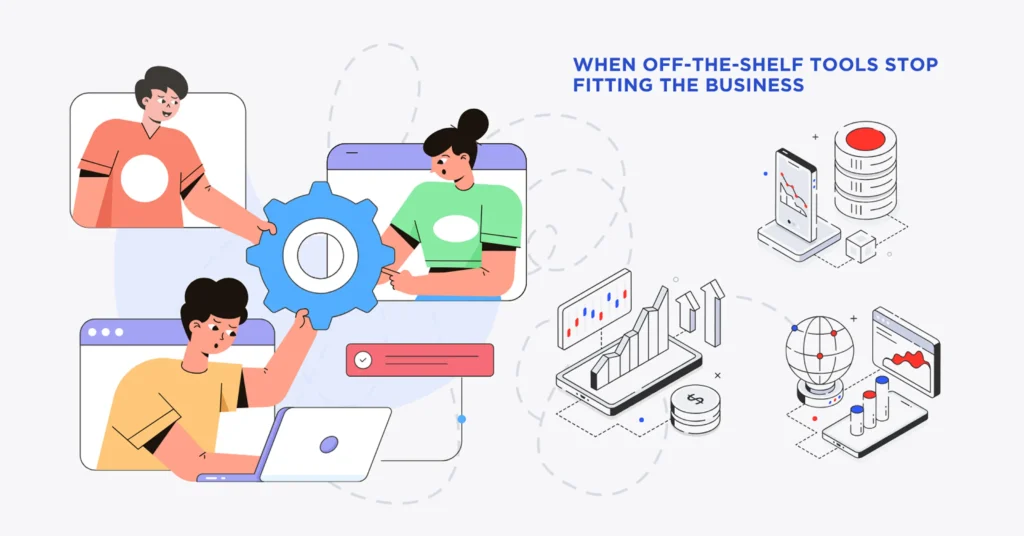
The choice is not “cheap vs expensive.” It is “standard fit vs specific fit.”
Off-the-shelf software wins when the problem is common. Email marketing, accounting, scheduling, basic CRM, simple ecommerce, and team chat often work well with existing tools.
Custom software wins when the process is unusual, the integrations are complex, the data is valuable, or the system becomes part of the company’s competitive edge.
| Question | Off-the-shelf software | Custom software |
| How fast can we start? | Usually faster | Slower at the beginning |
| How much can we change? | Limited by the vendor | Built around your workflow |
| Who controls the roadmap? | Vendor | Your business |
| What about ownership? | You pay for access | You can own the system and IP |
| Is it cheaper? | Often cheaper upfront | Can create better long-term ROI |
| Best use case | Standard business needs | Unique operations or growth systems |
Cost is where many companies make the wrong comparison. A subscription looks cheaper than development, but hidden costs can appear later: manual work, add-ons, user limits, integration patches, reporting gaps, and time lost to workarounds.
Security is another trade-off. Established vendors often have strong security, but the company depends on their policies and permissions. Custom software gives more control over access, data handling, and compliance, but only if it is built and maintained properly.
The real question is simple: will software be a support tool, or will it shape how the business runs?
What Companies Build With Custom Software
Custom business software usually appears in places where work is too important or too specific for generic tools.
A custom CRM helps sales and support teams manage relationships around their real customer journey, not a vendor’s template. An ERP platform connects inventory, procurement, finance, production, and reporting. Internal operations software manages scheduling, approvals, tasks, documents, budgets, quality control, or field work.
Customer portals let clients view orders, invoices, documents, support tickets, subscriptions, or project status without calling the team every time they need an update.
Workflow automation is often where ROI becomes obvious. A system can assign tasks, send reminders, generate documents, sync data, update statuses, notify customers, and remove repetitive admin work.
Industry-specific platforms go even further. A logistics company may need dispatching and tracking. A healthcare provider may need secure patient workflows. A manufacturer may need equipment monitoring. A real estate company may need listings, documents, leads, and tenant communication in one place.
Industries Where Custom Software Pays Off
Custom software is useful across industries, but the strongest cases usually share one thing: the business has workflows that are hard to standardize.
In healthcare, custom platforms support patient portals, appointments, telehealth, billing workflows, records, and care coordination. Privacy and reliability matter because the data is sensitive.
Financial services companies use custom systems for onboarding, dashboards, loan processing, compliance workflows, risk review, and reporting.
Ecommerce companies invest in custom software when product logic, checkout, subscriptions, inventory, loyalty, or marketplace features outgrow a standard setup. Even when a store starts on a platform like Shopify, growth often brings more specific needs: cleaner product pages, better checkout behavior, custom app integrations, faster storefront performance, or more flexible content management. That is when teams start looking beyond a basic theme and focus on what it takes to make the store work better as a business system.
Logistics teams need routing, dispatching, asset tracking, fleet visibility, warehouse workflows, and customer updates. Manufacturers use custom platforms for production planning, quality control, maintenance, inventory, equipment monitoring, and IoT-connected reporting.
Education and real estate also benefit when workflows become too specific for generic tools: learning portals, student dashboards, property management systems, booking flows, document handling, and lead routing.
IoT and Cloud Are Making Custom Software More Important
Some of the fastest-growing custom software projects now sit at the edge of the physical and digital world.
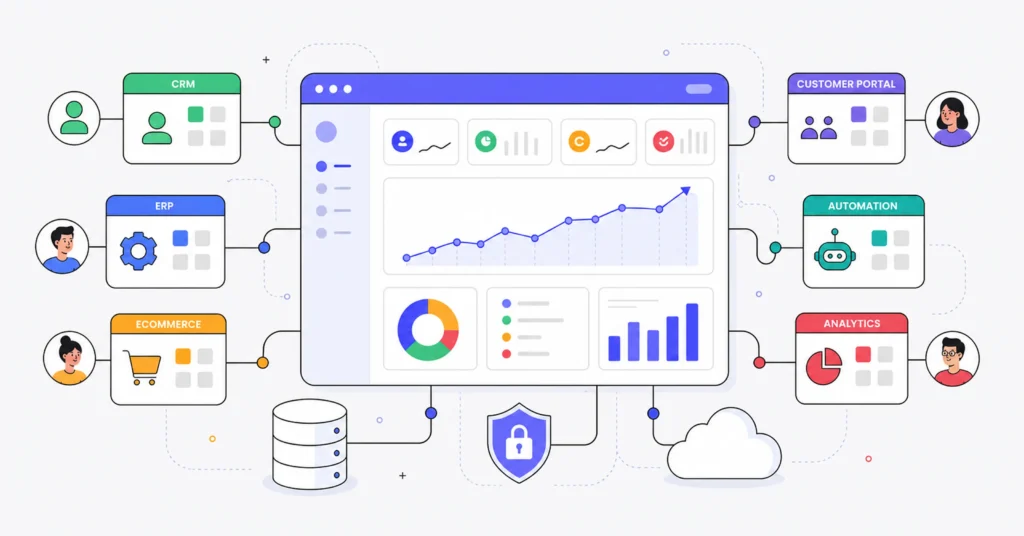
IoT software connects devices, sensors, machines, vehicles, buildings, or equipment to digital platforms. The device may collect the data, but the software turns that data into dashboards, alerts, reports, and decisions.
Custom IoT software can include smart device apps, industrial monitoring platforms, predictive maintenance tools, asset tracking systems, fleet dashboards, connected healthcare devices, and smart building applications.
A manufacturer may use sensor data to catch machine problems early. A logistics company may track vehicles in real time. A building operator may monitor energy use, access, occupancy, and safety from one dashboard.
Businesses looking for custom IoT software need partners who understand hardware integration, cloud infrastructure, secure APIs, data processing, device authentication, and what happens when devices disconnect.
Cloud software is another reason custom development is growing. Companies want systems that work across locations, support remote teams, scale with usage, and connect with other platforms.
Custom cloud software may run on AWS, Azure, Google Cloud, or a hybrid setup. AWS is common for scalable platforms, Azure fits many Microsoft-heavy organizations, and Google Cloud is often chosen for data-heavy systems and analytics.
The best cloud architecture is not the biggest one. It is the one that fits the product, traffic, data, security, and budget.
How Custom Software Gets Built
A good custom software project does not start with code. It starts with discovery.
Discovery is where the team studies the business goals, users, workflows, integrations, pain points, technical risks, budget, and success criteria. Skipping this stage is how companies end up building software that looks finished but solves the wrong problem.
After discovery comes architecture. This is where the team decides how the system will be structured: front end, back end, database, APIs, cloud setup, roles, permissions, integrations, security, and scalability.
Design turns that structure into user flows, wireframes, dashboards, forms, and screens. For business software, design is about helping people complete work with less confusion. This is also where older design-to-development workflows still matter. Some businesses come into a project with approved layouts, brand files, or legacy design assets that need to become a working website rather than stay inside a design folder. The quality difference usually appears in details like responsiveness, editable content blocks, page speed, and how carefully a static design is turned into a usable WordPress experience.
Development is where the system is built. Testing checks real behavior: features, integrations, mobile views, performance, security, and edge cases. Deployment moves the software into production with hosting, monitoring, backups, and launch checks.
Support starts after launch. Users find rough edges, integrations change, and security patches appear. Good custom software is maintained like a product, not abandoned like a completed file. The same is true for WordPress-based systems that sit close to marketing, lead generation, or customer communication. A site may not need a full internal development team, but it still needs someone to improve templates, fix performance issues, handle updates, and keep new requests moving. In that situation, companies often look at ways to keep WordPress work moving without overloading the internal team.
Technologies Behind Custom Software in 2026
The stack depends on the product. There is no universal best technology.
On the front end, React is common for SaaS platforms, dashboards, marketplaces, and interactive applications. For products with heavy user interaction, the real question is not whether React is popular, but whether the team can use it without turning the interface into a pile of disconnected components. That is where experience with building React around long-term product architecture becomes more valuable than simply knowing the library. Angular fits enterprise systems that need structure. Vue can work well for flexible business applications and smaller teams.
On the back end, Laravel is widely used for business platforms, admin panels, portals, APIs, and custom web applications. Laravel often fits projects where the business needs clean admin logic, secure user roles, custom workflows, and reliable integrations without overcomplicating the backend too early. For many companies, the decision comes down to whether the framework is used as a practical foundation for business software that has to grow, not just as a faster way to launch the first version. Node.js works well for real-time features and JavaScript-heavy teams. .NET remains strong in Microsoft-based environments. Java continues to power large-scale systems in finance, logistics, and enterprise operations.
Databases usually include PostgreSQL, MySQL, MongoDB, Redis, or a combination. APIs connect the system to CRMs, payments, accounting, shipping, analytics, IoT devices, or other platforms.
AI and machine learning are now part of many custom projects, but they should solve a real problem. Useful examples include recommendations, document processing, forecasting, fraud detection, chatbot support, personalization, and operational insights.
What Custom Software Costs
Custom software pricing depends on scope, complexity, integrations, security, infrastructure, and the team required.
A small MVP with core features and basic admin tools may cost $15,000 to $60,000. A business platform with user roles, dashboards, integrations, and automation often lands between $60,000 and $200,000. A complex SaaS or enterprise system can cost $200,000 to $1 million or more.
Those numbers are only ranges. A serious estimate needs discovery.
The biggest cost drivers are not always visible in the interface. Integrations, security, compliance, data migration, testing, and infrastructure decisions all add work.
The cheapest proposal is not always cheaper in the end. Poor architecture, missing documentation, and weak testing can turn a low initial price into an expensive rebuild.
Measuring ROI Without Guesswork
Custom software should be judged as a business investment, not just a development expense.
The simplest ROI formula is:
ROI = (Gain from the software – Cost of the software) / Cost of the software x 100
The difficult part is defining the gain.
Start with time. How many hours does the team spend on manual reporting, duplicate data entry, approvals, customer updates, document preparation, or status checks? Calculate what those hours cost over a month or year.
Add operational savings and revenue impact. Can the company reduce tool subscriptions, avoid repetitive admin work, reduce errors, shorten delivery time, improve conversion, speed up sales, or open a new service?
A logistics company may reduce dispatch time. An ecommerce company may improve checkout and inventory accuracy. A manufacturer may cut downtime with predictive maintenance. ROI becomes easier to measure when the project starts with a business problem, not a feature wish list.
How to Choose a Software Partner Without Regretting It Later
Choosing a development partner usually looks simple at the beginning. The business has an idea, a budget range, a few desired features, and a deadline. Several vendors send proposals. Someone compares prices. Someone checks portfolios. A call is scheduled.
The real difference between teams often appears later.
A serious software partner will not rush straight into development after hearing a feature list. They will want to understand how the company works, where the current process breaks, which users matter most, and what the system is supposed to improve. That can feel slower in the first week, but it usually saves months later.
The best teams are comfortable pushing back. They may question whether a feature belongs in the first release. They may suggest simplifying a workflow. They may warn that a specific integration will take longer than expected. They may explain why a cheaper technical shortcut could become expensive after launch.
That is not resistance. That is part of the job.
Technical skill is still essential. A custom software partner should understand product architecture, front-end development, back-end logic, databases, APIs, cloud infrastructure, security, testing, deployment, and maintenance. But technical ability alone is not enough. The team also needs to understand why the software is being built and how it will affect the business once real users start depending on it.
A good partner leaves a trail of clarity. Requirements are documented. Trade-offs are explained. Risks are discussed early. Communication feels consistent, not improvised. For agencies, the partner question can be even more sensitive because the client relationship stays with the agency while delivery may happen behind the scenes. That is why many teams compare the kind of WordPress partners that can work quietly inside another agency’s process before handing over client work. Case studies show more than screenshots; they explain the original problem, the decisions behind the solution, and what changed for the client after launch.
There are warning signs as well. Be careful with vendors who give a fixed price before understanding the scope, avoid questions about workflows, cannot explain their technology choices, treat testing as an afterthought, or disappear between meetings. Another red flag is the team that agrees with everything. In custom software, unlimited agreement often means the hard conversations are simply being delayed.
The working relationship before the contract usually tells you a lot. If the discovery call is vague, the proposal is thin, and communication already feels difficult, development is unlikely to feel better once deadlines and technical problems appear.
Custom software is not a one-time transaction. It is a long build, and sometimes a long relationship. The right partner should make the project clearer, not just cheaper.
The Custom Software Trends Worth Watching in 2026
Custom software is changing, but not every trend deserves equal attention. Businesses do not need to rebuild their systems every time a new tool becomes popular. What matters is whether a technology makes the product faster, safer, easier to maintain, or more useful for the people who rely on it.
AI is the most obvious shift. Development teams now use AI-assisted tools to speed up planning, coding, testing, documentation, and debugging. That does not remove the need for experienced developers. In many cases, it makes experience more important. AI can produce options quickly, but someone still has to decide which option is reliable, secure, maintainable, and right for the business.
Automation is also becoming more practical. Companies are moving beyond simple reminders and status updates. Modern custom platforms can analyze data, trigger workflows, suggest next steps, route requests, flag unusual activity, and reduce the number of manual decisions employees make every day.
Low-code tools are finding their place too, but mostly as part of a mixed approach. They can be useful for simple internal processes, prototypes, or temporary workflows. For core systems, complex integrations, sensitive data, or products that need to scale, custom development is still the safer long-term choice. Another quiet shift is happening inside agencies and service companies. Instead of hiring every specialist in-house, many are building delivery networks around trusted external teams, especially when client demand moves faster than internal capacity. The model is not new, but the conversation around how white-label delivery fits into modern agency growth has become much more practical.
Cloud-native architecture is becoming the default for many growing platforms. Managed databases, APIs, serverless functions, containers, monitoring tools, and automated deployments make it easier to build systems that can grow without constant rebuilding. The challenge is not using the cloud. The challenge is using it without making the system more expensive or complicated than it needs to be.
IoT is another area where custom software is becoming more important. Devices, vehicles, machines, sensors, buildings, and field operations are producing more data, but raw data has little value on its own. Businesses need dashboards, alerts, reports, automation, and secure infrastructure that turn connected systems into useful decisions.
Security now sits inside every serious software conversation. It cannot be left for the final week before launch. Access control, secure APIs, encryption, logging, backups, permissions, monitoring, and compliance need to be planned early. A platform may look finished on the surface and still be fragile underneath if security was treated as a checklist instead of part of the architecture.
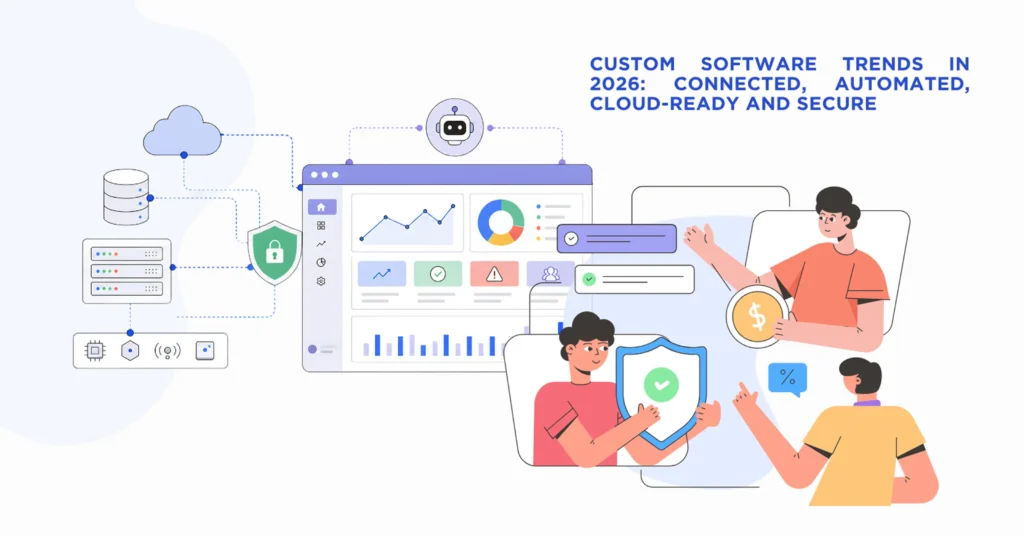
The strongest trend in 2026 is not one specific technology. It is the move toward software that is more connected, more automated, more cloud-ready, and more carefully protected from the start.
Mistakes That Make Custom Software More Expensive Than Planned
Custom software rarely becomes expensive because of one dramatic mistake. More often, the cost grows through small decisions that seemed harmless at the time.
One of the most common is choosing the cheapest proposal without understanding what is missing from it. A low price can look attractive during planning, especially when several vendors promise the same result. The problem appears later, when the code is hard to maintain, documentation is missing, testing was rushed, and every new feature takes longer than expected.
A cheaper build can become a more expensive rebuild.
Another mistake is skipping discovery. Many companies want to move straight into design and development because planning feels slow. But custom software depends on the details: how the workflow actually works, who uses the system, where data comes from, which integrations matter, what must happen automatically, and what can stay manual.
When discovery is weak, the software often copies the confusion already inside the business. Instead of fixing a broken process, it turns that process into a digital product.
Scalability is another area where teams often misjudge the problem. Not every MVP needs enterprise-level architecture, and overbuilding too early can waste money. But the opposite is just as dangerous. A system built only for today’s workload may struggle as soon as more users, more data, more roles, or more integrations are added.
Good scalability planning is not about building the biggest possible system from day one. It is about avoiding decisions that trap the business later.
Maintenance is easy to underestimate as well. Launch is not the finish line. Users will ask for changes. Integrations will update. Bugs will appear. Security patches will matter. Business rules will change. A custom platform needs someone responsible for keeping it healthy after the first release.
The final mistake is treating vendor selection as a purchasing task rather than a business decision. A weak development partner can misunderstand requirements, avoid difficult conversations, overpromise timelines, skip testing, and leave the company with software that technically exists but is painful to use.
This is especially important when a company brings in external developers to extend its capacity. The goal should not be to “rent hours” as cheaply as possible, but to understand how an outside development team will actually work with the business: who owns communication, how decisions are documented, how code is reviewed, and what happens after the first release.
The safest projects usually start with clear priorities, honest conversations, practical architecture, and a team that is willing to say when something does not make sense.
Is Custom Software Worth It?
Custom software is worth considering when a process is too important to keep patching with spreadsheets, disconnected tools, and manual workarounds. It makes sense when software affects revenue, customer experience, internal efficiency, reporting, compliance, or competitive advantage.
It makes less sense when the business has a standard need that an existing tool solves well.
The point is not to build custom software for everything. The point is to build it where fit matters.
In 2026, growing businesses are looking at software differently. They do not only need tools that help them operate today. They need systems that can adapt as the company changes.
That is the real value of custom software solutions. They give a business technology that follows its growth instead of holding it back.
Questions Business Owners Usually Ask
What is a custom software solution?
It is software built for one company’s specific needs instead of a broad market. It can be a portal, dashboard, CRM, ERP, mobile app, automation system, IoT platform, ecommerce tool, or cloud application.
When is custom software better than buying a ready-made tool?
Custom software is usually better when the workflow is unique, the data is spread across systems, integrations are complex, or the software directly affects revenue and operations. If a standard product solves the problem well, buying is often the smarter move.
What are examples of custom software for IoT?
Common examples include asset tracking platforms, fleet monitoring dashboards, smart building systems, predictive maintenance tools, industrial sensor dashboards, remote equipment monitoring, and connected healthcare device software.
Where can a company find custom cloud software solutions?
Work with a team experienced in cloud architecture, APIs, databases, security, deployment, and platforms such as AWS, Azure, or Google Cloud. The partner should be able to explain why a specific setup fits the business.
How do you measure ROI from custom software?
Measure time saved, errors reduced, tool costs removed, faster delivery, improved conversion, better customer experience, and new revenue opportunities. Then compare the annual gain with the cost of building and maintaining the software.
How much does custom software development cost?
A small MVP may start around $15,000 to $60,000. A mid-sized business platform may cost $60,000 to $200,000. Complex SaaS or enterprise software can move beyond $200,000 and sometimes exceed $1 million.
How long does it take to build?
A focused MVP may take 6 to 12 weeks. A business platform often takes 3 to 6 months. Larger enterprise systems can take 6 to 12 months or more, especially when integrations, security, compliance, and data migration are involved.
Who offers the best custom software solutions?
Usually, it is the team that understands the business problem, communicates clearly, shows relevant case studies, explains trade-offs, plans for security, and supports the product after launch.

Free website strategy session with a senior web expert
For over a decade, we’ve helped startups, SaaS companies, and service brands build high-performing websites that drive real results. Whether you’re planning a redesign, launching a new product, or need to scale your platform—our technical and UX expertise can help you move faster and smarter.
Ready to talk? Connect with a lead developer at Hutko.dev for a FREE 30-minute strategy call. Let’s map out your next step, together.
Book a Free Call
