



Outsourcing Mobile App Development: How to Build Faster Without Losing Control

- When Outsourcing Mobile App Development Makes Sense
- Choose the Right Outsourcing Model
- Prepare a Brief Before Talking to Vendors
- Look for Relevant Product Experience
- Review the Vendor’s Broader Portfolio
- Ask About the Development Process
- Testing, Devices, and Release Readiness
- Budget and Contract Structure
- Protect Ownership, Access, and IP
- Communication Makes or Breaks the Project
- When Web and Mobile Outsourcing Overlap
- A Short Checklist Before You Outsource
- Build Faster, But Keep Control
A mobile app idea usually starts with momentum.
A founder sees a gap in the market. A company wants to give customers a better way to book, buy, track, or communicate. An agency wins a client project but does not have enough mobile developers available. A product team has a roadmap, but the internal engineers are already overloaded.
Then the practical question appears: who is going to build it?
Hiring full-time mobile developers can take time. Building an in-house team for iOS, Android, backend APIs, QA, design, and release management may be too expensive before the product has proven itself. That is why many companies look at outsourcing mobile app development.
But outsourcing is not simply about finding cheaper developers.
Done well, it helps a team build faster, fill skill gaps, and reduce hiring pressure. Done badly, it creates unclear scope, weak ownership, missed deadlines, and a product nobody wants to maintain.
The difference usually comes down to preparation, communication, and the development model.
When Outsourcing Mobile App Development Makes Sense
Outsourcing works best when there is a clear product goal but not enough engineering capacity to reach it.
A startup may need to launch a mobile MVP quickly before hiring an internal team. A growing company may need iOS, Android, React Native, Flutter, or backend mobile API expertise that it does not have in-house. A digital agency may need extra delivery capacity for a client project. An established business may want to modernize an older app without interrupting the internal roadmap.
Teams that want a smaller, product-minded partner often look for outside help from groups such as the Hutko team, especially when they need both design thinking and engineering execution.
Outsourcing is less effective when nobody on the client side owns the product. If there is no decision-maker, no time for feedback, and no clear business priority, an external team will struggle no matter how skilled it is.
The client does not need to manage every technical detail.
But someone still has to make product decisions.
Choose the Right Outsourcing Model
Not every outsourcing model fits every project.
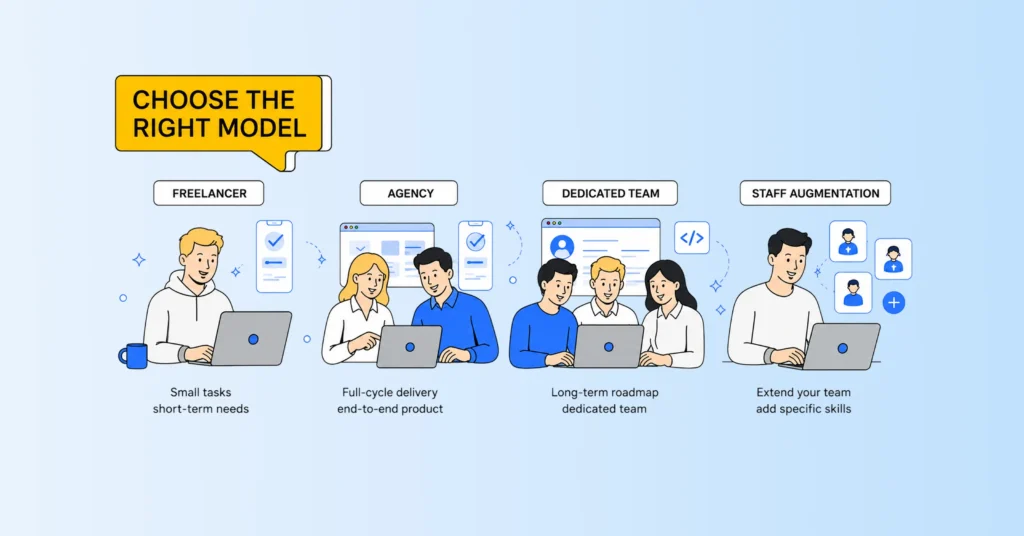
A freelancer can be a good choice for small fixes, isolated screens, or short-term tasks. The risk is availability. If something breaks or the scope grows, one person may not have the time or range of skills to cover the full product.
A development agency is usually a better fit for full-cycle mobile app development. This model makes sense when the project needs UX/UI design, backend development, QA, app store preparation, and project management in one process.
A dedicated team works well for longer roadmaps. The client gets an external team that functions almost like an internal engineering unit, often with developers, QA, designers, and a project manager working continuously on the product.
Staff augmentation fits companies that already have product management and technical leadership but need extra developers. In this case, the client controls the process, while the external specialists add capacity.
The wrong model creates friction. A complex app should not be treated like a small freelance task. A simple MVP may not need a large dedicated team from day one.
Prepare a Brief Before Talking to Vendors
A weak brief usually leads to vague estimates.
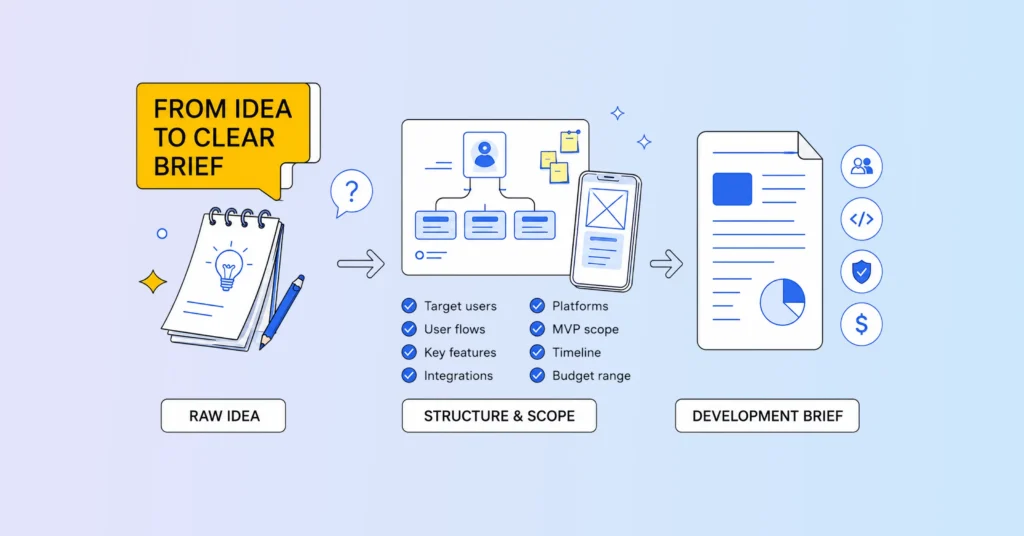
Before speaking with app development vendors, write down the basics. The brief does not need to be perfect, but it should make the product understandable.
- What problem does the app solve?
- Who are the target users?
- What are the main user flows?
- Do you need iOS, Android, or cross-platform development?
- Will the app need payments, booking, chat, maps, notifications, or subscriptions?
- Is there an admin dashboard or customer portal?
- Which systems need to be integrated?
- Are there security or compliance requirements?
- What should be included in the MVP?
- What timeline and budget range are realistic?
The clearer the brief, the easier it is to compare vendors. Without it, every estimate is built on assumptions.
Look for Relevant Product Experience
A portfolio should be reviewed carefully.
Screenshots are not enough. A polished interface does not tell you whether the team handled payments, subscriptions, provider workflows, location logic, admin panels, or release issues.
Look for experience with flows similar to your product. A booking app has different risks from a food delivery platform. A marketplace is different from a simple content app. A subscription product has different logic from a one-time payment flow.
For example, a mobile booking app for car care services shows how scheduling, provider workflows, customer accounts, payments, and admin visibility can come together in one product.
The point is not to find an identical case study.
The point is to see whether the team understands the type of complexity your product will have.
Review the Vendor’s Broader Portfolio
One strong case study helps, but it should not be the only signal.
Before choosing a mobile app development partner, review selected product work across different industries and product types. This gives a better sense of how the team approaches user experience, backend logic, admin tools, mobile delivery, and complex workflows.
A good portfolio should show range. Look for different industries, different user flows, and evidence that the team can work beyond simple landing pages or visual design.
The strongest vendors explain the problem behind the project, not just the final result.
Ask About the Development Process
A reliable outsourced mobile app development team should not jump straight into coding.
The process usually starts with discovery. The team clarifies goals, users, core flows, risks, integrations, and acceptance criteria. Then comes UX/UI design, technical architecture, MVP planning, sprint-based development, QA testing, and release preparation.
For mobile products, release work matters more than many clients expect. App Store and Google Play preparation, permissions, analytics, crash reporting, and post-launch monitoring should be part of the conversation early.
If a vendor cannot explain how they move from idea to launch, that is a warning sign.
Testing, Devices, and Release Readiness
Mobile apps require more testing than many web products.
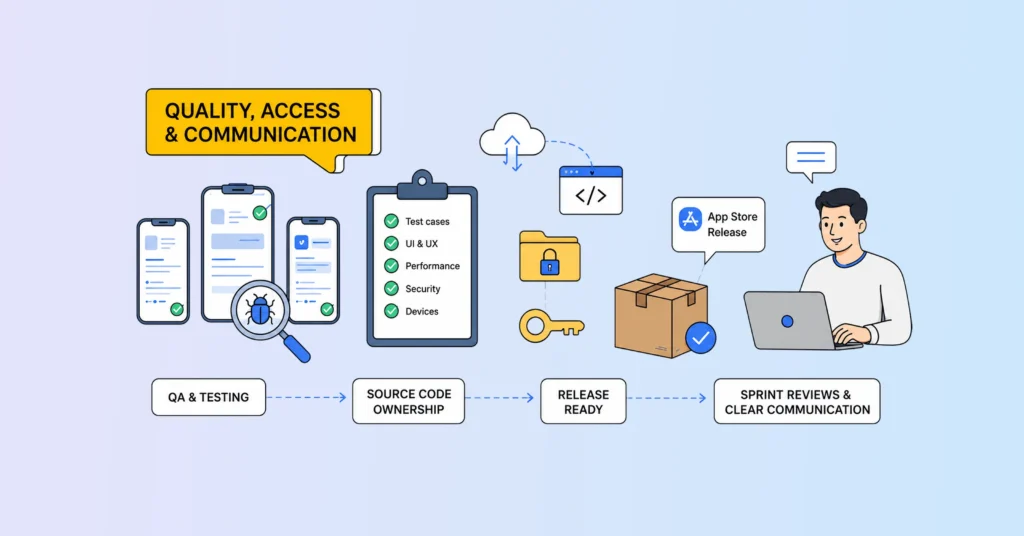
Different screen sizes, operating system versions, permissions, device settings, payment flows, push notifications, and app store rules can all create problems.
A serious QA process should include real-device testing, emulator-based testing, regression testing, payment testing, notification testing, crash reporting, and analytics checks.
Even before real-device QA begins, teams can reduce early issues by testing iOS flows before release and checking how important screens behave in different environments.
The goal is not only to find bugs.
The goal is to avoid a weak first release.
Budget and Contract Structure
Mobile app development cost depends on scope, team size, design complexity, integrations, backend requirements, QA, and post-launch support.
Do not compare vendors only by hourly rate. A cheaper hourly rate can become expensive if discovery is weak, testing is missing, or the code needs to be rebuilt later.
| Pricing model | Best fit | Main risk |
| Fixed price | Clear MVP scope with limited changes | Scope changes can become expensive |
| Time and materials | Products that need flexibility | Budget needs active management |
| Dedicated monthly team | Longer roadmaps and ongoing development | Requires steady product direction |
| Hybrid milestone model | Projects with phases and review points | Milestones must be clearly defined |
Clarify what is included in the estimate: discovery, design, development, QA, DevOps, app store release, documentation, and maintenance.
Also define what counts as a change request. Many conflicts start when one side thinks a feature is included and the other side sees it as new scope.
Protect Ownership, Access, and IP
Before signing, make ownership clear.
The agreement should explain who owns the source code, design files, app store accounts, repositories, documentation, and third-party service accounts.
The client should have access to the code repository, App Store Connect, Google Play Console, analytics tools, payment accounts, and any infrastructure created for the product.
An NDA may be useful, but it is not enough. IP ownership, handover rules, and access rights matter just as much.
A mobile app is not only a build. It is a product asset.
Communication Makes or Breaks the Project
Outsourcing does not remove the need for client involvement.
The best projects have weekly demos, sprint reviews, written decisions, clear backlog ownership, and fast feedback on designs and builds.
A dedicated product owner on the client side helps the external team move faster. That person does not need to write code. They need to answer questions, make decisions, prioritize features, and keep stakeholders aligned.
Time-zone overlap also matters. A few shared working hours can prevent days of delay.
Good communication is not about more meetings.
It is about fewer surprises.
When Web and Mobile Outsourcing Overlap
Many mobile apps are not only mobile apps.
They also need backend systems, admin dashboards, APIs, marketing websites, CMS pages, customer portals, analytics, or internal tools.
For companies that need a mobile app plus dashboards, backend tools, or customer-facing web features, outside engineering support can be a practical way to extend the team without slowing the product roadmap.
This is especially common in marketplaces, delivery products, booking platforms, SaaS tools, and ecommerce apps.
The mobile interface may be what users see first, but the web infrastructure often keeps the product running.
A Short Checklist Before You Outsource
- Is the MVP scope written down?
- Do you know whether you need iOS, Android, or cross-platform development?
- Is there a product owner on your side?
- Are the key integrations listed?
- Have you defined what success looks like?
- Do you know who owns the source code?
- Will the repository be under your account?
- Are payment milestones clear?
- Is QA included in the estimate?
- Is app store release support included?
- Is post-launch maintenance included?
Build Faster, But Keep Control
Outsourcing mobile app development works best when it is treated as a structured partnership, not a quick handoff.
The right partner should help define scope, identify risks, protect product ownership, build in short feedback cycles, and support the app after launch.
The client should bring product knowledge, fast decisions, and clear priorities.
That balance is what keeps outsourced mobile app development from becoming chaotic.
Speed matters. Cost matters. But control matters just as much.
The best outsourcing relationships are built around clear scope, working software, transparent communication, and a shared understanding of what the product needs to become.

Free website strategy session with a senior web expert
For over a decade, we’ve helped startups, SaaS companies, and service brands build high-performing websites that drive real results. Whether you’re planning a redesign, launching a new product, or need to scale your platform—our technical and UX expertise can help you move faster and smarter.
Ready to talk? Connect with a lead developer at Hutko.dev for a FREE 30-minute strategy call. Let’s map out your next step, together.
Book a Free Call
