



How to Outsource Web Development in 2026: Cost, Models, and Checklist

- What Is Web Development Outsourcing?
- When Should a Business Outsource Web Development?
- Web Development Outsourcing Models
- How Much Does It Cost to Outsource Web Development?
- What Impacts the Cost Most?
- Choose the Right Stack Before Development Starts
- How to Outsource a Web Development Project Step by Step
- How to Choose a Web Development Outsourcing Company
- Examples of Outsourced Web Development Projects
- Common Outsourcing Mistakes to Avoid
- Final Checklist Before Hiring an Outsourced Web Development Team
- Need a Web Development Outsourcing Partner?
Outsourcing web development usually starts with a simple problem.
The company needs to move faster than its internal team can manage.
A startup wants to launch an MVP before hiring a full engineering department. An ecommerce brand needs a better storefront before the next sales season. A marketing team needs landing pages, tracking, and CMS updates faster than the backlog allows. An agency has client work coming in, but not enough developers to deliver everything on time.
At that point, outsourcing stops being a cost-cutting idea and becomes a delivery decision.
In 2026, the pressure is real. The U.S. Bureau of Labor Statistics projects employment for software developers, quality assurance analysts, and testers to grow 15% from 2024 to 2034, with about 129,200 openings each year. Hiring strong developers is not getting easy, especially for companies that need delivery now rather than six months from now. :contentReference[oaicite:0]{index=0}
That is why more businesses are looking at outsource web development services as a practical way to add design, frontend, backend, QA, DevOps, and support capacity without building every role internally.
But outsourcing only works when it is managed properly.
The wrong partner can create unclear scope, poor communication, missed deadlines, hidden costs, weak QA, and a website nobody wants to maintain. The right partner can help a business launch faster, reduce technical pressure, and keep product development moving.
This guide explains how to outsource web development in 2026, what it usually costs, which models to compare, what mistakes to avoid, and what to check before hiring an outsourced web development team.
What Is Web Development Outsourcing?
Web development outsourcing means hiring an external team or specialist to plan, design, build, test, improve, or maintain a website or web application.
It is not just “finding cheap developers.”
A serious outsourcing partner can support UX/UI design, frontend development, backend development, CMS work, ecommerce development, API integrations, QA testing, DevOps, performance optimization, security improvements, and post-launch support.
For a small business, outsourcing may mean hiring a team to rebuild a WordPress website. For a startup, it may mean building an MVP web app. For an ecommerce company, it may mean improving Shopify performance and checkout flow. For an agency, it may mean extending delivery capacity behind the scenes.
The core idea is simple: the business keeps control of the goal, while an external team helps deliver the technical work.
When Should a Business Outsource Web Development?
Outsourcing makes sense when the business need is clear, but internal capacity is limited.
One common case is speed. A company may need a landing page, MVP, ecommerce update, or web application delivered faster than hiring allows.
Another case is missing expertise. A business may have a marketing team but no developers. Or it may have backend developers but no frontend specialist. Or it may need a Shopify, WordPress, React, Laravel, or DevOps expert for a specific project.
Outsourcing also works when the workload is uneven. A company may need heavy development support before launch, lighter support after release, and then another sprint of work before the next campaign.
Common reasons to outsource website development include:
- No in-house development team.
- Internal developers are overloaded.
- The business needs to launch an MVP quickly.
- A specific technical skill is missing.
- The company needs frontend, backend, QA, and DevOps together.
- A website or web app needs ongoing support after launch.
- An agency needs extra delivery capacity for client work.
- The business wants to control cost without permanent hiring.
Outsourcing is not the right answer when nobody inside the company owns the project. An external team can build, advise, test, and support. It cannot replace product decisions, business priorities, or customer knowledge.
Web Development Outsourcing Models
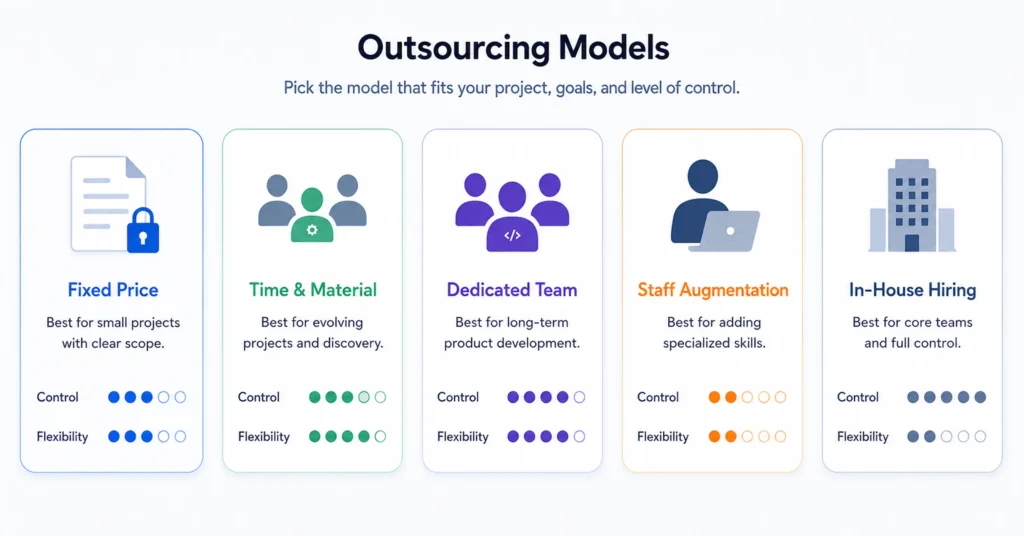
Not every outsourcing model works the same way.
Before choosing a vendor, it helps to understand how the engagement will be managed. The model affects budget, flexibility, communication, risk, and how much control the client keeps.
| Model | Best for | Pros | Risks |
| Fixed price | Small projects with clear scope | Predictable budget and deliverables | Poor fit when requirements change |
| Time and material | Projects where scope may evolve | Flexible, practical for discovery and iteration | Budget needs active management |
| Dedicated team | Long-term product development | Continuity, product knowledge, scalable capacity | Needs clear product ownership from the client |
| Staff augmentation | Adding specialists to an existing team | Fast access to specific skills | Client manages delivery day to day |
A fixed-price model can work for a simple corporate website, landing page, or tightly defined WordPress build.
Time and material is often better for web applications, MVPs, dashboards, integrations, or projects where the details will change after discovery.
A dedicated team makes sense when the roadmap is longer than one release. This is common for SaaS platforms, marketplaces, ecommerce systems, and custom business software.
Staff augmentation is useful when a company already has a strong internal process and only needs extra developers to join the existing workflow.
How Much Does It Cost to Outsource Web Development?
There is no honest single price for outsourced web development.
A landing page, a WordPress rebuild, a Shopify store, and a custom SaaS platform are completely different projects. The cost depends on scope, complexity, team location, design requirements, integrations, CMS needs, security, QA, and support.
Market pricing also changes. A 2025 report citing Accelerance outsourcing data found that software developer hourly rates declined by 9% to 16% across several regions, while Latin America remained steadier because time-zone proximity became more valuable for AI-driven development workflows. :contentReference[oaicite:1]{index=1}
That does not mean businesses should choose only by hourly rate.
A cheaper hourly rate can become expensive if the team lacks QA, project management, senior oversight, documentation, or post-launch support.
| Project type | Typical scope | Planning range |
| Landing page or small marketing site | Design, frontend, CMS setup, basic forms | $2,500–$12,000 |
| WordPress business website | Custom theme, templates, CMS blocks, performance work | $8,000–$35,000 |
| Shopify store | Theme customization, apps, product pages, checkout improvements | $7,000–$40,000 |
| Custom web application MVP | Frontend, backend, database, user roles, core features | $20,000–$80,000 |
| Complex SaaS or marketplace | Dashboards, payments, integrations, admin panel, QA, DevOps | $80,000–$250,000+ |
| Dedicated monthly team | Developers, QA, PM, design or DevOps support | $12,000–$60,000+ per month |
These are planning ranges, not guaranteed quotes.
A serious estimate should come after discovery. The vendor needs to understand what is being built, how many roles are needed, what systems must be integrated, how much QA is required, and what happens after launch.
What Impacts the Cost Most?
The biggest cost driver is not always the number of pages.
A ten-page website with complex integrations can cost more than a larger content website with simple templates. A small web app with payments, user permissions, and admin logic may require more engineering than a polished marketing site.
Costs usually increase when the project includes:
- Custom UX/UI design.
- Complex frontend interactions.
- Backend business logic.
- API integrations.
- Payments or subscriptions.
- CRM or ERP connections.
- Custom CMS workflows.
- Security requirements.
- Migration from an old website.
- Performance optimization.
- Multi-language content.
- QA across browsers and devices.
- Post-launch support.
The best way to control cost is not to cut testing or senior oversight. It is to define the first release clearly.
A focused MVP usually costs less than a half-finished product trying to include everything at once.
Choose the Right Stack Before Development Starts
Some outsourcing problems begin with technology decisions that were made too quickly.
The stack should follow the project. A content-heavy marketing website, a SaaS dashboard, a Shopify store, a WordPress lead-generation site, and a custom Laravel backend do not need the same setup.
For frontend-heavy products, teams often compare React, Vue, Angular, and modern meta frameworks. React is common for dashboards, SaaS interfaces, marketplaces, and web apps with many reusable components. If the project depends on long-term interactive UI work, React development outsourcing can help keep the frontend architecture cleaner than a quick component-by-component build.
For backend-heavy products, Laravel is often used for business platforms, admin panels, portals, APIs, and custom workflows. Companies that need clean backend logic, user roles, dashboards, integrations, and maintainable application structure may look at Laravel development services when PHP is a good fit for the project.
For ecommerce projects, the stack usually depends on how the store actually makes money. A small Shopify store may only need cleaner theme work, better app setup, and a few improvements to product pages. A growing brand usually needs more than that: faster pages, custom sections, cleaner checkout behavior, better analytics, and integrations that do not slow the store down. That is where Shopify development services can be useful, especially when the goal is to make the store work better as a revenue channel, not just make it look different.
WordPress has not disappeared from serious web projects. It is still a practical choice for content-heavy websites, lead generation, service businesses, and marketing teams that need to publish often. The problems usually start later, when the site needs new templates, landing pages, performance fixes, CMS improvements, or technical updates faster than the internal team can handle. In that situation, WordPress development outsourcing can be a more realistic option than letting every small website task sit in a backlog.
How to Outsource a Web Development Project Step by Step
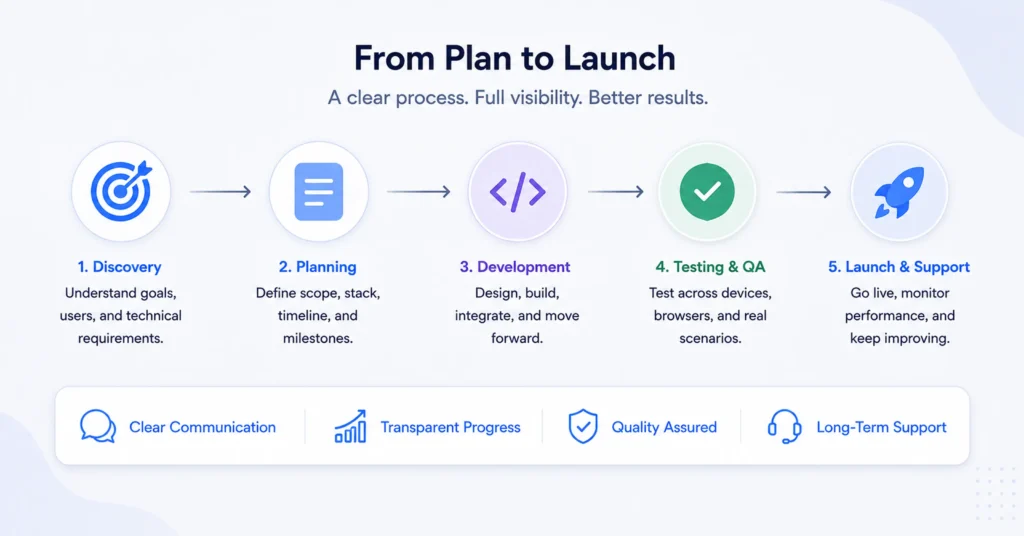
Outsourcing works better when the company prepares before contacting vendors.
A weak brief leads to vague estimates. A vague estimate leads to conflict later.
Prepare a clear brief
Start with the business problem. Explain what the website or web app should do, who will use it, what is broken today, and what result matters after launch.
Describe the scope
List the main pages, user flows, features, integrations, admin needs, CMS requirements, and must-have launch items.
Choose the likely technology stack
You do not need to make every technical decision alone. But you should know whether the project is likely to involve WordPress, Shopify, React, Laravel, Webflow, a custom backend, or a headless setup.
Check portfolios and case studies
Look beyond screenshots. A strong portfolio should show workflows, dashboards, integrations, mobile behavior, admin tools, and business logic.
For example, a car wash app development case study can show how booking, service flows, payments, mobile UX, and admin visibility work together in a real product environment.
Run a discovery call
A good discovery call should include questions about goals, users, scope, integrations, risks, timeline, budget, and support expectations.
Sign the right documents
Use an NDA when needed. Make sure the contract covers scope, payment terms, IP ownership, source code access, confidentiality, support, change requests, and handover.
Break the work into milestones
Milestones make progress visible. They also reduce the risk of waiting until the end to discover that expectations were different.
Include QA and post-launch support
Testing should not be optional. Neither should support after launch. Websites and web apps need updates, fixes, monitoring, and improvements once real users arrive.
How to Choose a Web Development Outsourcing Company
The best vendor is not always the cheapest one or the one with the nicest homepage.
A strong web development outsourcing company should make the project clearer before it makes promises. The team should ask about business goals, users, workflows, technical risks, deadlines, integrations, and what happens after launch.
Look for signals that the company can handle both delivery and communication.
- Relevant case studies, not only visual portfolio items.
- Clear discovery process.
- Transparent estimates with assumptions.
- Project manager or delivery lead.
- Frontend and backend expertise.
- QA process included in the workflow.
- Security and access control awareness.
- Timezone overlap for communication.
- Comfortable English communication.
- Written milestones and acceptance criteria.
- Post-launch support options.
Pay attention to how the vendor behaves before the contract.
If communication feels vague during sales, it usually does not become clearer during development.
Examples of Outsourced Web Development Projects
Outsourced web development can cover much more than a simple website build.
It can include customer portals, booking platforms, ecommerce stores, SaaS dashboards, marketplace features, internal admin tools, WordPress websites, Shopify improvements, and custom web applications.
Before hiring a team, review whether its work matches the type of product you are building.
A business that needs a high-converting WordPress site should not judge vendors only by SaaS dashboards. A company building a custom web app should not choose a team that only edits templates. An ecommerce business should look for proof that the vendor understands product pages, checkout, apps, analytics, and performance.
If you are planning agency delivery or WordPress-heavy client work, it may also help to read a white label WordPress outsourcing guide before choosing how much work should stay in-house and how much can be handled by an external team.
Common Outsourcing Mistakes to Avoid
Most bad outsourcing experiences start early.
The first mistake is starting without a brief. If the vendor does not understand the goal, the estimate will be built on guesses.
Another expensive mistake is choosing a vendor only because the hourly rate looks low. A cheap estimate can hide the things that actually protect the project: senior review, QA, documentation, project management, clean handover, and support after launch. The real cost appears later, when every change takes longer than expected.
Ownership should also be discussed before the first sprint starts. The contract needs to make clear who owns the source code, design files, repositories, content, accounts, infrastructure, and any custom assets created during the project. If that is not written down early, the handover can become painful later.
QA is another place where companies try to save money and usually regret it. A website can look finished in a demo and still have broken forms, weak mobile behavior, slow pages, tracking problems, checkout issues, or integration bugs. Testing is not a final polish step. It is part of the build.
The fifth mistake is forgetting post-launch support. A launch is not the end. CMS users need help. Plugins change. APIs update. Traffic exposes performance issues. Real users find problems that were not obvious in staging.
The sixth mistake is outsourcing responsibility instead of work. The client still needs someone to approve decisions, answer product questions, and keep priorities clear.
Final Checklist Before Hiring an Outsourced Web Development Team
- Is the business goal clear?
- Is the first release scope written down?
- Which features are essential for launch, and which ones can wait?
- Are the key pages, user flows, forms, and integrations already listed?
- Is the project likely to need WordPress, Shopify, React, Laravel, Webflow, or a custom stack?
- Has the vendor shown case studies that match the type of project you are building?
- Does the estimate explain its assumptions, or is it just a number?
- Who is responsible for QA before launch?
- Who manages the project and keeps communication clear?
- Is post-launch support included, or will it be billed separately?
- Who owns the source code, design files, repositories, and key accounts?
- Where will repositories and accounts be hosted?
- How will milestones be approved?
- How often will demos or updates happen?
- What happens if scope changes?
- What happens if something breaks after launch?
Need a Web Development Outsourcing Partner?
Outsourcing web development works best when it is treated as a structured partnership, not a quick handoff.
The client brings business goals, product knowledge, priorities, and feedback. The development team brings technical execution, process, QA, architecture, and delivery discipline.
That balance is what keeps outsourcing from becoming chaotic.
If you are planning a website, web app, ecommerce project, or long-term development roadmap, you can talk to HUTKO about your project and discuss which outsourcing model makes the most sense for your timeline, stack, and budget.

Free website strategy session with a senior web expert
For over a decade, we’ve helped startups, SaaS companies, and service brands build high-performing websites that drive real results. Whether you’re planning a redesign, launching a new product, or need to scale your platform—our technical and UX expertise can help you move faster and smarter.
Ready to talk? Connect with a lead developer at Hutko.dev for a FREE 30-minute strategy call. Let’s map out your next step, together.
Book a Free Call
