



White Label WordPress Development for Agencies: Complete Outsourcing Guide

- What Is White Label WordPress Development?
- Who Needs WordPress Development Outsourcing?
- What Can You Outsource to a WordPress Partner?
- Figma or PSD to WordPress Still Matters
- White Label WordPress vs Freelancers vs In-House Team
- How the White Label WordPress Workflow Should Look
- Quality Checklist for Outsourced WordPress Projects
- Pricing Factors in WordPress Outsourcing
- WooCommerce, Shopify, and Choosing the Right Ecommerce Path
- Red Flags When Choosing a White Label WordPress Agency
- How Agencies Can Protect the Client Relationship
- How This Fits Into Broader Web Development Outsourcing
- How HUTKO Helps Agencies Scale WordPress Development
Most agencies do not lose WordPress projects because they cannot sell them.
They lose them because delivery becomes messy.
A client approves a redesign, but the agency does not have enough developers available. A marketing team needs landing pages every month, but the internal team is busy with campaign work. A design studio has beautiful Figma files, but no reliable WordPress partner to turn them into a clean, editable website. An SEO agency needs technical improvements, speed fixes, redirects, and schema work, but the development backlog keeps growing.
This is where white label WordPress development starts to make sense.
The agency keeps the client relationship. The external WordPress team handles development behind the scenes. The final work is delivered under the agency’s brand.
Done well, this model helps agencies accept more projects, protect margins, improve delivery speed, and offer WordPress development without hiring a full in-house engineering team.
Done badly, it creates missed deadlines, weak QA, unclear ownership, client frustration, and emergency fixes after launch.
This guide explains how white label WordPress outsourcing works, what agencies can outsource, how to compare vendors, what affects pricing, and what to check before trusting another team with your client work.
What Is White Label WordPress Development?
White label WordPress development is a partnership model where an external development team builds WordPress websites, features, themes, landing pages, WooCommerce stores, or support work for an agency’s clients, while the agency presents the work under its own brand.
In simple terms, the client sees the agency.
The agency works with the development partner in the background.
For example, HUTKO can handle the WordPress development, QA, staging, deployment, and technical support, while the agency manages client communication, strategy, design direction, and final approvals.
This is why many digital agencies use white label WordPress development when they want to expand delivery capacity without exposing the client relationship or hiring every specialist internally.
The model is especially useful when WordPress work is steady but not predictable enough to justify a full-time team. One month may bring a full website build. The next month may bring only support, landing pages, or urgent fixes. A white label partner helps smooth out that workload.
Who Needs WordPress Development Outsourcing?
White label WordPress outsourcing is not only for large agencies.
It can be useful for any business that sells, manages, or depends on WordPress work but does not want to build a full development department around it.
Digital agencies use it when they need more production capacity for client websites, redesigns, technical updates, or custom WordPress builds.
SEO agencies use it when technical implementation slows down campaign results. They may need Core Web Vitals improvements, schema markup, redirects, page templates, blog structure, plugin cleanup, or content hub development.
Design studios use it when they create the visual direction but need a reliable partner to turn Figma, Sketch, or PSD designs into responsive WordPress websites.
Marketing agencies use it when clients need campaign landing pages, lead-generation forms, CRM integrations, A/B test pages, tracking setup, and ongoing website support.
SaaS and product teams may use WordPress as a marketing site, documentation hub, or content engine while their internal developers focus on the product itself.
Founders and ecommerce teams also use WordPress development outsourcing when they need flexible technical support without hiring a full-time developer.
The common thread is simple: the agency or business owns the client relationship and strategy, but needs reliable WordPress execution.
What Can You Outsource to a WordPress Partner?
WordPress outsourcing can cover small technical tasks or full website delivery.
The right scope depends on the agency’s internal strengths. Some agencies outsource only development. Others outsource QA, maintenance, speed work, WooCommerce customization, or ongoing support.
Common WordPress tasks agencies outsource include:
- Custom WordPress theme development.
- Figma, Sketch, or PSD to WordPress conversion.
- Landing page development.
- WooCommerce setup and customization.
- Plugin customization.
- Custom post types and advanced fields.
- WordPress speed optimization.
- Core Web Vitals improvements.
- Security hardening.
- Website maintenance and updates.
- Technical SEO implementation.
- Schema markup and redirects.
- CRM and marketing tool integrations.
- Multilingual WordPress setup.
- Bug fixes and emergency support.
Some projects require basic implementation. Others need professional WordPress development services because the site must support custom workflows, editable content blocks, performance requirements, or more complex backend logic.
The important point is to define what you want to keep in-house and what should be handled by the white label team.
An agency may want to own strategy, UX, copy, and client communication while outsourcing development and QA. Another agency may want the partner to help with technical planning from the first discovery call.
Figma or PSD to WordPress Still Matters
Many agencies still begin with design files.
A client approves a visual direction in Figma, Sketch, or Photoshop. The design looks ready. The real challenge starts when that static design has to become a responsive, editable, fast WordPress website.
This is where quality differences become obvious.
A weak build may look close to the design on desktop but break on mobile, load slowly, rely on too many plugins, or make content hard for the client to edit. A strong build keeps the design intent while creating clean templates, flexible sections, logical CMS fields, and responsive behavior that survives real content.
For agencies that still receive legacy design assets or approved static layouts, PSD to WordPress services can be part of a broader delivery workflow, especially when the final website needs to be both visually accurate and practical for the client to manage.
Design-to-WordPress work is not just slicing a file.
It is the point where design becomes a working product.
White Label WordPress vs Freelancers vs In-House Team
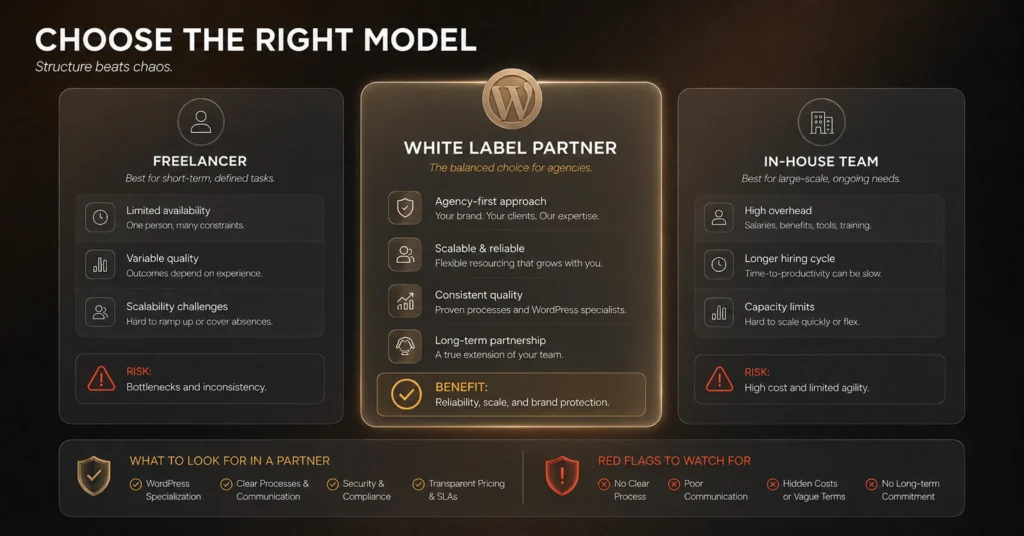
Agencies usually compare three options when WordPress demand grows: hire in-house, use freelancers, or work with a white label WordPress partner.
Each model has its place.
Freelancers can be useful for small tasks, emergency fixes, or limited support. In-house teams give maximum control. White label partners sit between those two options: more structure than a freelancer, less hiring burden than building a full department.
| Model | Best for | Main advantage | Main risk |
| White label WordPress partner | Agencies with recurring or unpredictable WordPress work | Scalable capacity, process, QA, agency-friendly delivery | Needs clear communication and workflow alignment |
| Freelancer | Small fixes, isolated tasks, short-term support | Flexible and often lower cost | Limited availability, limited coverage, higher dependency on one person |
| In-house team | Agencies with steady long-term WordPress volume | Full control and direct communication | Hiring cost, salaries, management, retention, idle time between projects |
| Project-based vendor | One-off website builds with clear scope | Defined deliverables and timeline | Less useful for ongoing support or changing client needs |
The best choice depends on project volume, budget, client expectations, and how much technical responsibility the agency wants to keep internally.
For agencies that need delivery support without turning every project into a hiring decision, white label usually offers the best balance.
How the White Label WordPress Workflow Should Look
A good white label workflow should feel boring in the best possible way.
Everyone knows what happens next. Requirements are clear. Staging is used properly. QA is not skipped. The agency has enough visibility to manage the client confidently.
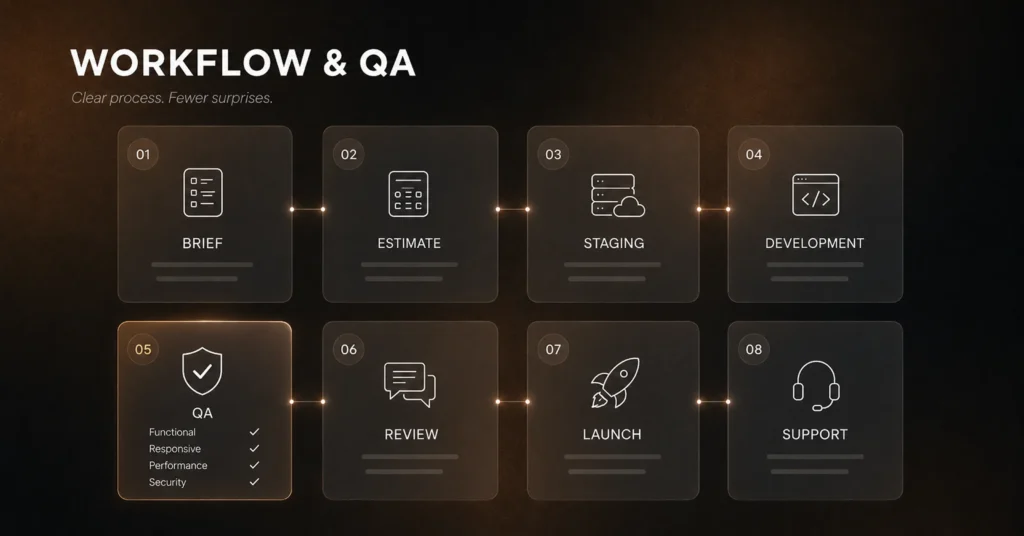
The usual workflow should look like this:
- NDA and partnership setup.
- Project brief and technical requirements.
- Estimate with assumptions and timeline.
- Access setup and staging environment.
- Development milestones.
- Internal QA by the WordPress partner.
- Agency review before client presentation.
- Client review through the agency.
- Final fixes and launch preparation.
- Deployment and post-launch support.
The agency should never feel blind during the process.
Progress should be visible through staging links, task tracking, regular updates, and clear handoff notes. If the partner disappears for two weeks and returns with a “finished” build, the risk is already too high.
Agencies that also outsource design sometimes combine WordPress delivery with white label web design services, especially when they need both design and development capacity but still want to keep the client relationship under their own brand.
Quality Checklist for Outsourced WordPress Projects
White label work has to be quiet, but it cannot be careless.
The client may never know another team helped with development. But the client will notice if the site is slow, hard to edit, broken on mobile, or unstable after launch.
Before delivering a WordPress project to the client, the agency and development partner should check:
- Responsive design across common screen sizes.
- Clean HTML structure.
- Logical heading hierarchy.
- Editable content areas for the client.
- Core Web Vitals basics.
- Image optimization.
- Font loading and asset optimization.
- Plugin audit and removal of unnecessary plugins.
- Security basics and admin access rules.
- Backups configured before launch.
- Staging environment used before production changes.
- Form testing and email delivery checks.
- CRM or marketing integrations tested.
- SEO basics, including titles, meta fields, schema, and redirects.
- 404 page and redirect behavior checked.
- Browser testing.
- Post-launch smoke test.
QA should not happen only at the end.
A good white label partner tests during development, before agency review, before client review, and after deployment. That rhythm protects the agency’s reputation.
Pricing Factors in WordPress Outsourcing
White label WordPress pricing depends on the type of work and how much responsibility the partner takes on.
A simple landing page is not priced the same as a custom WordPress website. A WooCommerce build is not the same as plugin cleanup. A performance optimization sprint is different from monthly maintenance.
The main pricing factors include:
- Number and complexity of page templates.
- Whether the design already exists.
- Custom theme development.
- WooCommerce functionality.
- Plugin customization.
- Third-party integrations.
- Advanced Custom Fields or custom post types.
- Multilingual setup.
- Migration from an old website.
- Speed optimization.
- Security requirements.
- QA depth.
- Support after launch.
- Urgency and timeline.
| Project type | Typical scope | Pricing impact |
| Landing page | One page, form, responsive build, basic CMS | Lower |
| Business website | Multiple templates, editable sections, SEO basics | Medium |
| Custom WordPress theme | Design system, custom templates, flexible CMS blocks | Medium to high |
| WooCommerce project | Products, checkout, payment setup, store logic | Medium to high |
| Ongoing support | Updates, fixes, performance, landing pages, maintenance | Monthly or retainer-based |
Agencies should be careful with extremely low estimates.
A cheap WordPress build may skip QA, rely on too many plugins, ignore performance, or create templates the client cannot edit properly. That usually costs more later.
WooCommerce, Shopify, and Choosing the Right Ecommerce Path
Many agencies deal with ecommerce clients who ask the same question: should we use WooCommerce or Shopify?
There is no universal answer.
WooCommerce can be a good fit when the client already depends on WordPress, needs content flexibility, wants strong control over the website, or has a catalog that fits the WordPress ecosystem.
Shopify can be a better fit when the client wants a hosted ecommerce platform, simpler store management, strong checkout infrastructure, and faster store operations without managing as much technical complexity.
For agencies, the decision should be based on the client’s business model, catalog complexity, content needs, integrations, budget, and long-term support expectations.
If the project is better suited for Shopify than WooCommerce, it may be worth comparing WordPress ecommerce work with Shopify development services before committing the client to the wrong platform.
The goal is not to force every ecommerce project into WordPress.
The goal is to choose the platform that the client can actually grow with.
Red Flags When Choosing a White Label WordPress Agency
A white label partner has direct influence over your agency’s reputation.
That makes vendor selection more sensitive than ordinary outsourcing.
Some red flags are easy to spot before the first project starts:
- No NDA or white label agreement.
- No staging environment.
- No QA process.
- No clear communication rhythm.
- No project manager or delivery contact.
- No explanation of ownership and handover.
- No post-launch support option.
- No experience with agency workflows.
- No willingness to work behind your brand.
- No documentation after delivery.
- Too many plugins used for basic functionality.
- Unrealistic deadlines without scope discussion.
Be especially careful with teams that promise everything immediately.
A reliable partner will ask questions. They will want to see designs, requirements, access details, plugin lists, hosting setup, content structure, and client expectations before giving a serious estimate.
If the sales process feels vague, the development process usually will too.
How Agencies Can Protect the Client Relationship
The biggest fear agencies have with white label outsourcing is simple: losing control of the client experience.
That risk is real if the workflow is not defined.
The agency should decide how the partner communicates, what tools are used, whether the partner joins client calls, how staging links are shared, and who sends final updates. Some agencies want the white label team completely invisible. Others allow the partner to join calls under the agency’s name.
Both models can work.
The important thing is to agree before the project starts.
Agencies should also keep ownership of strategy, client communication, approvals, and account access. The development partner should make delivery smoother, not create confusion about who owns the relationship.
How This Fits Into Broader Web Development Outsourcing
White label WordPress outsourcing is one part of a larger outsourcing strategy.
An agency may outsource WordPress development today, Webflow next month, React later, and ecommerce work after that. The important question is not only which platform is being used. It is how the agency builds a reliable delivery network.
If your team is still deciding which outsourcing model fits different types of web projects, this guide on how to outsource web development can help compare fixed price, dedicated team, staff augmentation, and project-based delivery.
That bigger view matters because WordPress is often only one part of the client’s digital ecosystem.
A client may need a WordPress marketing site, a Shopify store, a custom portal, and ongoing landing page production. Agencies that can coordinate those needs with reliable partners are easier to trust.
How HUTKO Helps Agencies Scale WordPress Development
White label WordPress development works best when the partner understands both sides of the project.
On one side, there is technical delivery: clean WordPress development, responsive templates, performance, plugin discipline, QA, security basics, staging, deployment, and support.
On the other side, there is the agency relationship: deadlines, client expectations, communication style, approvals, scope changes, and protecting the agency’s brand.
HUTKO supports agencies that need WordPress development capacity without hiring an internal team for every project. That can include full website builds, Figma or PSD to WordPress development, landing pages, WooCommerce work, maintenance, technical SEO tasks, performance improvements, and ongoing support.
The goal is not to replace the agency.
The goal is to help the agency deliver more work under its own brand, with less delivery pressure and fewer technical bottlenecks.
If your agency needs a reliable WordPress partner for upcoming projects, you can get a quote for WordPress outsourcing and discuss the workflow, scope, timeline, and level of white label support you need.

Free website strategy session with a senior web expert
For over a decade, we’ve helped startups, SaaS companies, and service brands build high-performing websites that drive real results. Whether you’re planning a redesign, launching a new product, or need to scale your platform—our technical and UX expertise can help you move faster and smarter.
Ready to talk? Connect with a lead developer at Hutko.dev for a FREE 30-minute strategy call. Let’s map out your next step, together.
Book a Free Call
