



White Label SaaS Explained: How to Build Scalable Services in 2025

- What Is White Label SaaS and How Does It Work?
- Why Agencies and Entrepreneurs Choose White Label SaaS
- Types of White Label SaaS Products You Can Offer
- How to Choose the Best White Label SaaS Platform
- Step-by-Step Guide: How to Launch a White Label SaaS Business
- Challenges to Watch Out For (And How to Solve Them)
- Real Benefits for Your Agency or Startup
- Conclusion: Should You Launch a White Label SaaS in 2025?
- Want to explore white-label SaaS for your agency?
It’s no secret SaaS is everywhere right now—but what’s turning heads in 2025 is how many people are getting into it without building anything themselves. More agencies and solo operators are tapping into white label SaaS as a way to grow faster, offer more value, and skip the technical grind entirely.
The idea is simple: instead of spending months (and serious money) developing your own tool, you take a working platform, rebrand it with your name, and offer it to your clients as your own. You control the pricing. You handle the onboarding. You own the relationship.
It’s not just a passing trend. As more service-based businesses look for ways to shift toward recurring income, white label SaaS gives them a productized path forward—without having to become developers.
This guide will walk you through what white label SaaS is, which types of products are worth offering, how to evaluate platforms, and how to launch your own offering the smart way.
What Is White Label SaaS and How Does It Work?
At its core, white label SaaS is software developed by one company and resold by another under its own branding.
You get access to a working platform—CRM, analytics tool, booking system, and more—then apply your brand’s look and feel. Your clients use it as if it were your own creation.
How it works:
- A software vendor builds and maintains the product.
- You subscribe as a reseller or agency partner.
- You customize the branding, URL, and pricing.
- You sell access to your clients and keep the profits.
Common use cases:
- CRM and lead management
- Email marketing and automation
- SEO reporting and analytics
- SMS marketing
- Social media scheduling
- Booking and appointment tools
Why Agencies and Entrepreneurs Choose White Label SaaS
For a lot of agencies and solo founders, the appeal of white label SaaS isn’t just about the software. It’s about creating something scalable—without getting bogged down in development or hiring. You’re not building tech. You’re building a business model that works behind the scenes.
Here’s why so many are making the shift:
- It cuts out months of development. You don’t need to plan a roadmap, hire engineers, or fix bugs. The product already works—you’re simply rebranding it and putting it in front of your clients.
- You can start selling almost immediately. Once you set up your branding and pricing, you’re ready to go. No dev cycles, no endless testing phases.
- Your brand stays front and center. Clients see your name, your design, your emails. You’re not reselling someone else’s brand—you’re offering a complete solution under your own.
- You create monthly recurring income. Instead of one-time service fees, you build a subscription-based model that compounds over time.
- You grow your offering without growing your team. Since the product is maintained by someone else, you don’t need extra developers or support staff. You focus on marketing, onboarding, and customer relationships.
For tech-driven firms—like a white label Laravel agency building scalable backends—white label SaaS offers a clean way to add recurring revenue without stretching your engineering resources.
Types of White Label SaaS Products You Can Offer
If you’re trying to figure out what kind of white label SaaS makes sense for your clients, don’t overthink it. The most successful offerings tend to solve simple, familiar problems—things your clients are already paying for elsewhere.
In fact, the best place to start is with tools your audience already uses. That way, you’re not introducing something new—they’re just getting it from you instead of a faceless platform.
Some proven categories to consider:
- Email marketing (think newsletter builders, automations, contact lists)
- CRMs for sales and client tracking
- SEO and analytics dashboards
- Social media content planners
- Live chat and chatbot solutions
- Shopify customer support tools (ideal if you offer Shopify outsourcing services)
If your audience includes local business owners, marketing managers, or service providers, chances are they’re already paying for one or more of the above. Repackaging it with your branding helps you deepen the relationship while building a revenue stream that doesn’t rely on billable hours.
How to Choose the Best White Label SaaS Platform
Now, just because a platform says “white label” doesn’t mean it’s the right fit.
Some are solid and built for scale. Others? Not so much. You don’t want to sell something that breaks under pressure or looks like a bad clone of a well-known tool.
Here’s what actually matters when you’re comparing options:
- Is the platform stable? (Downtime = support nightmares.)
- Can you fully rebrand the experience—your logo, your domain, your emails?
- Does it offer API access or integrations with tools your clients use?
- How quickly can you get it live without custom dev work?
- What’s the pricing model—and does it leave enough room for your margin?
And here are a few things to stay away from:
- Platforms that only “partially” white-label (your brand still shares space with theirs)
- Long-term contracts with no flexibility or trial period
- Weak mobile support, or clunky UI that feels outdated
- No access to the product roadmap or update schedule
Bottom line: if you wouldn’t use it yourself, don’t sell it under your name.
Step-by-Step Guide: How to Launch a White Label SaaS Business
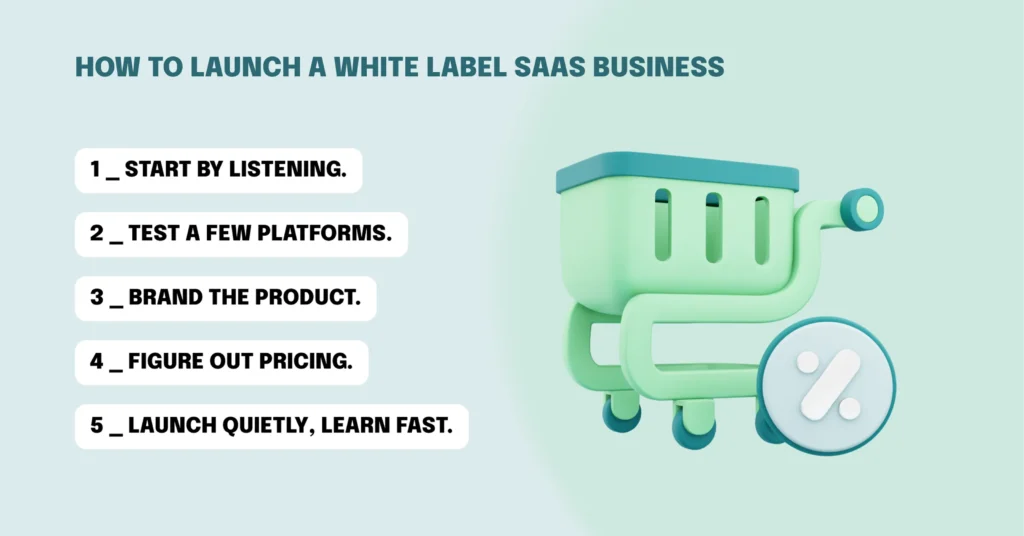
You don’t need a dev team. You don’t even need a new website. If you’re already offering front-end services like Webflow white label development, this can be an effortless way to upsell clients with a software component.
Here’s how most people approach it (and what works):
- Start by listening. What tools are your clients already using? What do they complain about?
- Test a few platforms. Don’t just look at features—use them like a client would.
- Brand the product. Get your logo, colors, and support links in place. Make it feel like your software.
- Figure out pricing. Don’t undercut—package it in a way that adds value (like bundled support, templates, or onboarding).
- Launch quietly, learn fast. Share with a few trusted clients first, gather feedback, then roll it out more widely.
Remember, you don’t need 1,000 users on day one. Start with five that actually pay—and build from there.
Challenges to Watch Out For (And How to Solve Them)
Launching a white label SaaS isn’t without its bumps in the road. While it’s far simpler than building your own product, there are still a few challenges that tend to come up—especially in the early stages.
Here are some of the most common issues and how to handle them:
1. You can’t track what your users are doing.
If your platform doesn’t provide usage stats or behavior tracking, you’ll struggle to measure adoption or retention.
What to do: Look for platforms with built-in reporting or ones that integrate easily with tools like Google Analytics or Mixpanel.
2. You’re unsure how to price it.
Many first-time resellers underprice out of fear or try to match the vendor’s retail rates. That’s a fast track to razor-thin margins.
What to do: Focus on the value you provide—not just the tool. Include onboarding, templates, or support to justify a premium.
3. Clients hesitate to switch tools.
This is especially true for site owners already using legacy platforms like WordPress. As an outsourced WordPress provider, you can make the switch easier by offering pre-migrated templates and familiar UI.
What to do: Make the transition easy. Offer hands-on demos, free trials, or even done-for-you setup to ease the shift.
4. Support takes up too much of your time.
You may find yourself answering questions that really should go to the platform’s developers.
What to do: Choose vendors who offer white-label support—or consider hiring a VA to handle first-line issues using your documentation.
It’s all manageable. The key is to prepare for these issues instead of being surprised by them.
Real Benefits for Your Agency or Startup
Whether you run a marketing firm or a white label WordPress development agency, white label SaaS isn’t just a way to make extra income—it’s a shift in how you structure your business. For agencies especially, it opens the door to a more product-driven model without abandoning the service work you already do well.
Here’s what that looks like in practice:
- You stop relying solely on billable hours and start building income that stacks every month.
- You offer more value to clients, without growing your internal team or adding operational overhead.
- You improve client retention by becoming not just their service provider—but their software provider too.
- You increase the lifetime value of every client by layering product + service in one relationship.
And maybe most important? You’re building something scalable. Instead of trading time for money, you’re investing in assets that grow with or without you.
Conclusion: Should You Launch a White Label SaaS in 2025?
Yes, if you’re looking to grow without writing code or managing developers.
Start small. Choose one or two SaaS products your clients already need. Brand them. Wrap them with onboarding, support, and education. Then scale.
White label SaaS allows you to become a product company without the complexity of traditional product development.
Want to explore white-label SaaS for your agency?
Start by choosing a product your clients already need and rebrand it as your own. Need help picking or customizing a platform? Reach out to our team for a free consultation.

Free website strategy session with a senior web expert
For over a decade, we’ve helped startups, SaaS companies, and service brands build high-performing websites that drive real results. Whether you’re planning a redesign, launching a new product, or need to scale your platform—our technical and UX expertise can help you move faster and smarter.
Ready to talk? Connect with a lead developer at Hutko.dev for a FREE 30-minute strategy call. Let’s map out your next step, together.
Book a Free Call
